Book Review: Till Taught by Pain
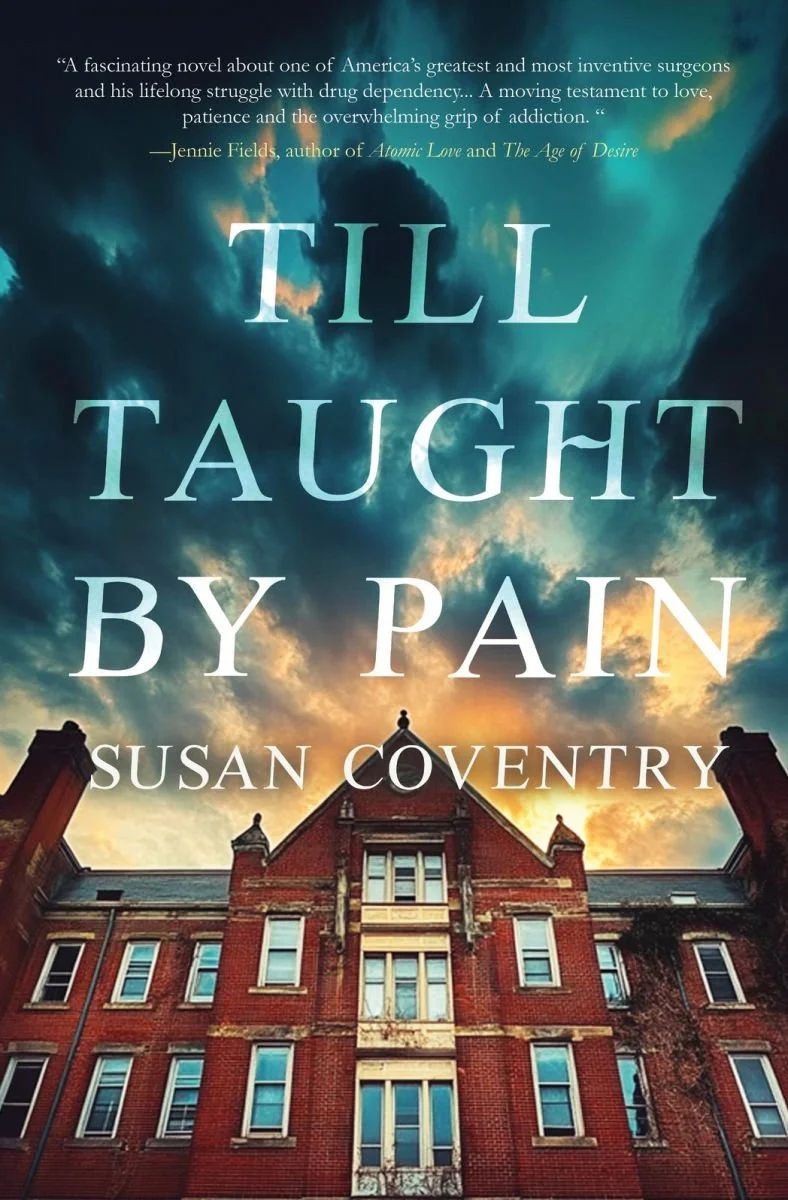
Till Taught by Pain, Susan Coventry, Regal House Publishing. LLC, November
2025, Paperback, 299 pages.
Reviewed by Catherine Marcroft.
Susan Coventry’s Till Taught by Pain is a very satisfying read. In this historical novel in three parts, we are first introduced to young Dr. William Halsted. A brilliant medical mind coming of professional age when the new frontier of medical science is a wide open, collaborative, international affair. Discoveries in the field by all male, American doctors are credited and celebrated – as ego demands – but also enthusiastically shared with doctors of European countries. Moving fast, occasionally throwing caution to the wind.
Dr. William Halsted is a true historical figure for whom we are all grateful, whether we know it or not. He conceived of multiple new procedures – for example, the life-saving radical mastectomy – and made strides in the field of anesthetics that made possible many surgeries not previously attempted. He invented new tools when old ones were insufficient. To save the hands of an excellent surgical nurse whose skin suffered in the face of his strict aseptic techniques, he requested a prototype of rubber surgical gloves from the Goodyear Rubber Company. They caught on (I love knowing that detail)! He insisted that part of the work was passing on knowledge gained to the next generation of doctors, initiating the concept of surgical residency. He was a part of the prestigious teaching hospital, Johns Hopkins at its inception in1893 in Baltimore, Maryland.
The second act of this book brings us to another historical figure, Caroline Hampton, raised by three aunts when the deaths of her mother and then her father leave her a very young orphan. She was the niece of Wade Hampton III, a former Confederate general, Governor of South Carolina and a US Senator of that state. The Hamptons are proud, Old South with expectations for their young. Her aunts were certain she would find a wealthy plantation owner with whom she could settle down. When another uncle, Kit, the General’s brother, falls into a long illness, it is Caroline who nurses him and in doing so discovers her calling. She is smart, attentive, and determined to leave home and enroll in nursing school. She completes her training and eventually gets a job working with the brilliant surgeon, Dr. Halsted. She quickly shows her worth, demanding of herself skills to match the inspired work that he is doing. And yes, Caroline is the excellent surgical nurse Dr. Halsted wants not to lose to her sensitive skin.
The love story in these pages is passionate but not sentimental. Both Caroline and William come to us as intelligent, fully aware human beings, sure of who they are, where they come from and their purpose. Neither is looking for romance, in fact actively avoiding it. They are both intentionally in pursuit of purpose, one of tremendous value for their own sake as well as the greater good.
Deciding to marry would seem to be a loss, especially for Caroline. Societal expectations of the time would require her to give up nursing. She accepts sincerely though and without bitterness. We come to both admire and thank her for that in the end. It’s also clear that the compassion and love she feels for her husband make her the only person who could have helped shoulder the unceasing, harrowing consequences of his groundbreaking early work in anesthetics, specifically cocaine. Without her, the accomplishments of her brilliant husband would have been very much cut short. No one accomplishes greatness on their own.
"Till taught by pain, men know not water's worth" is a famous quote from Lord Byron's epic satirical poem Don Juan paraphrased by Dr. Halsted’s well-read, life-long friend Dr. Welch. The sentiment of not knowing the worth of a thing until it is gone is brought into sharp focus many times throughout the doctor’s life. I find the title clever in that it can be applied both as a metaphor for addiction as well as to the loss of life’s true gifts that addiction might tempt one to risk.
Throughout Susan Coventry offers such intelligent writing and wonderful archival context that I immediately relaxed into reading this book with tremendous trust. There is much historical fact here and everywhere she fills in the gaps rings true.