Book Review: The Way Beauty Comes Apart
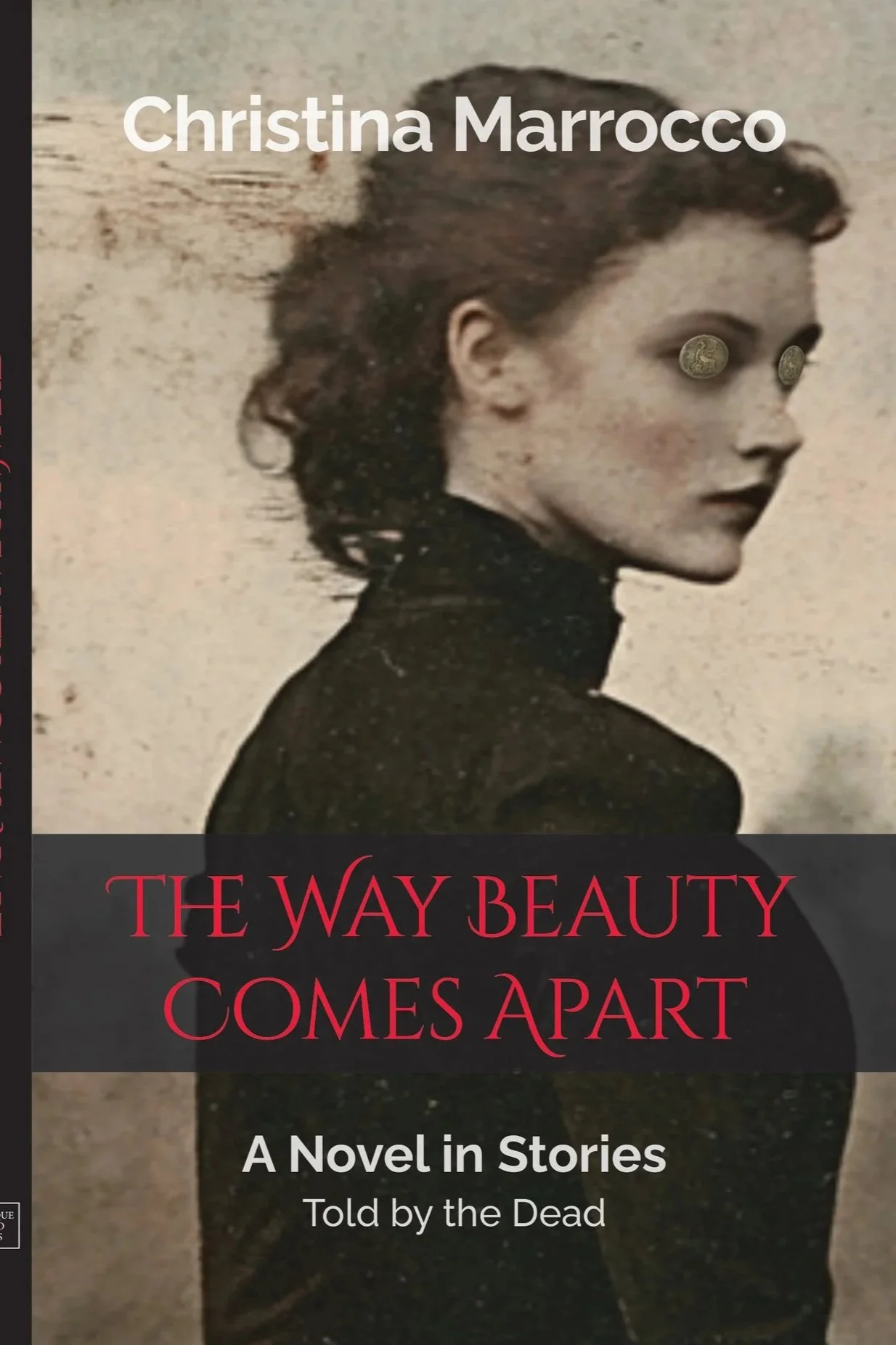
The Way Beauty Comes Apart: A Novel in Stories, Told by the Dead. Christina Marrocco, Ovunque Siamo Press, August 2025, paperback and e-book, 206 pages.
Reviewed by Amy Purcell.
After their deaths, the characters in Christina Marrocco’s absorbing novel-in-stories share their pivotal moments in all their messy human glory. Love blooms, mistakes are made, secrets are kept, and violence is concealed. Misunderstandings and missed opportunities crop up as often as the fields’ stones in the fictional North West Wales village of Nefin.
Each story holds a comforting universality, exploring themes of loss, grief, love, longing, faith, hope, and death. Set mostly in the Victorian and Edwardian eras, The Way Beauty Comes Apart is equal parts pastoral and confessional.
Among the strongest is the title story, featuring Cranstal Jones, who grieves the loss of her three daughters and sinks into a stupor, eroding her marriage to Gwilym, who harbors deadly secrets of his own. Gazing at her daughters’ graves, Cranstal believes “there had been such hope in the pain.” In many ways, this theme binds the novel’s fourteen narrators.
Nefin’s spinster, Aggie Monroe, hides away in her hillside home above the village with the love of her life, Aderwen, who—after years of marriage and raising children—escapes her husband, Twm Gethin, a loathsome character readers will love to hate for a variety of reasons. Young Lili Morgan dreams of moving to London to enter the fashion industry until her life takes a tragic, violent turn. Marged Dafydd, a midwife, taught ancient healing practices by her grandmother of the same name, knows more of the townsfolk’s secrets than she lets on. As for her grandmother, the elder Marged fears the onslaught of the modern world and laments that her natural healing practices will be buried along with her. Other characters, like shopkeepers, farmers, religious fanatics, and children, bring Nefin to life, making readers feel as if they’ve made new friends in this tight-knit, yet fractured community.
Marrocco’s true magic lies in the sparkling specificity of each story. She deftly weaves together the trials and triumphs that connect the characters. Marrocco’s passion for research and history shines through the intriguing details about everything from corpse candles to cot deaths to midwifery medicine, and how to keep the “fair folk” (e.g., fairies) pleased by placing a dish of bread at the door. While the overall tone is quiet, conflict and complexity rumble beneath the surface. When the connections among the Jones, Priddy, Morgan, Dafydd, Gethin, and Monroe families are revealed, they are both surprising and satisfying.
The village of Nefin itself feels like a character that readers may be reluctant to leave. I found myself fantasizing about taking a trip to Wales while reading. According to one of Marrocco’s footnotes, the town’s name, Nefin, means “shadow place,” which is appropriate given that the narrators speak from the grave as they reflect on their former lives. One gets the sense that each narrator wants, for one final time, to be seen and heard.
When Aggie Monroe contemplates her somewhat staid life, she says to the reader, “I’ve told you my story, if it’s a story at all. I like to think it’s not. It’s simply a life.” When Marrocco presents these characters’ lives, they may seem simple on the surface, but they are anything but. These stories possess psychological, emotional, and spiritual depth that will stay with you long after the book is closed.
A fitting complement to the novel is Rob Dunbar’s cover design, which features a portrait of a woman with coins placed over her eyes. In Victorian-era European traditions, coins were placed over the eyes of the deceased to prevent the soul from returning or looking around and taking someone with it, while also serving the practical purpose of keeping the eyelids shut. Like Marrocco’s stories, the image is both grounded and haunting.