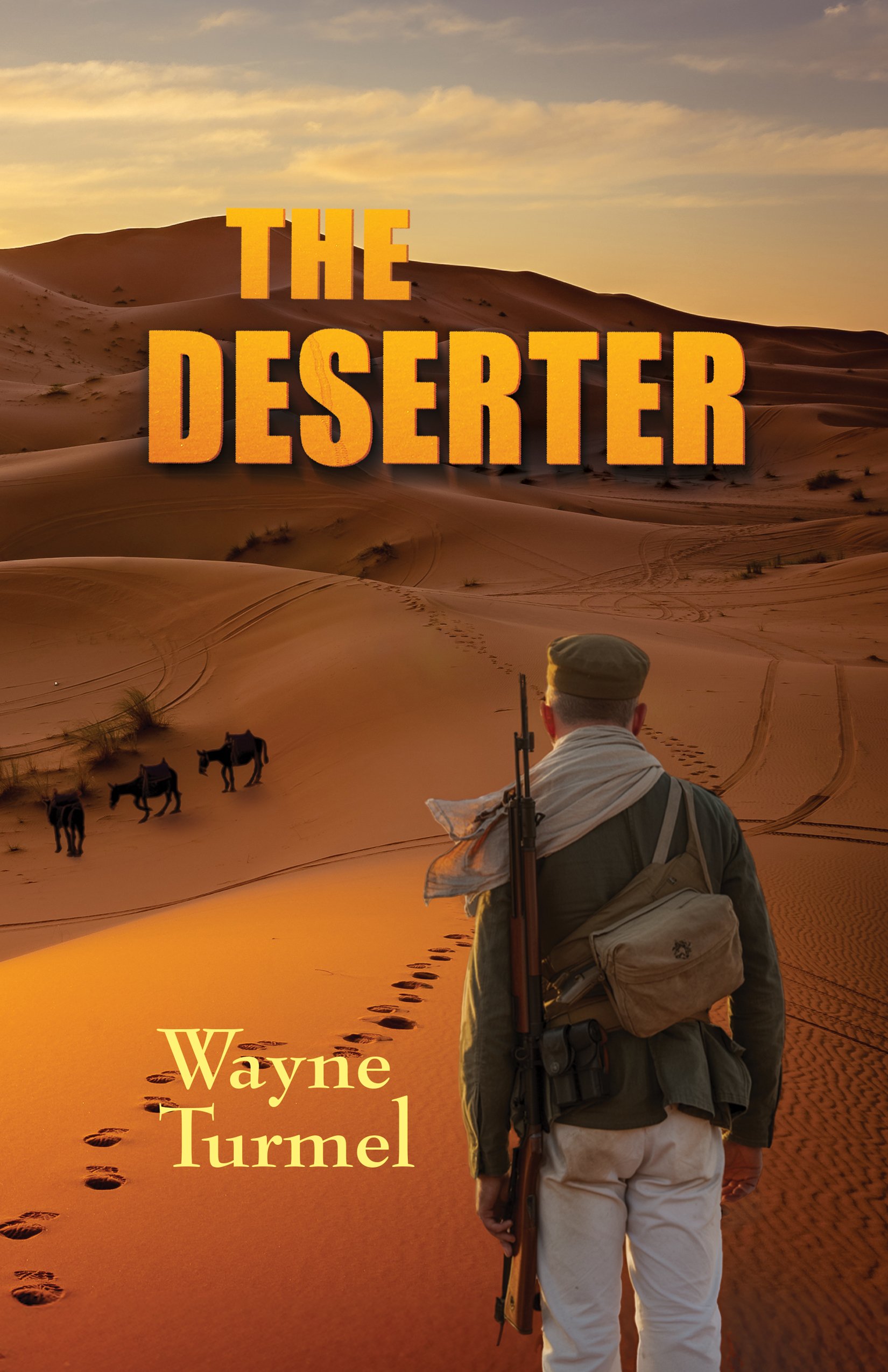
The Deserter: A Tale of the Foreign Legion. Wayne Turmel, Achis Press, January 2026, paperback and e-book, 256 pages.
Reviewed by Andrew Reynolds.
Wayne Turmel, author of Middle Eastern-based novels like The Count of the Sahara, Acre's Bastard, and its sequel, Acre's Orphans, has gone back to this setting with his newest novel, The Deserter- a Tale of the Foreign Legion (available January 15, 2026 on the Kindle platform for $4.99, or in print for $21.99 from Achis Press). Working with editor Ruth Zakarian, Turmel has turned out a 78,000 word narrative that follows his protagonist on a journey from despair all the way to outright madness.
It’s 1908, and Gil, the center of this tale and a man known by many names, is an individual with a dubious background.
Once known as a soldier fighting against the Boers for England and Queen Victoria, as the story opens, he’s a down-on-his-luck dweller of the back alleys of Marseilles. As it happens, he’s also a wanted man, needing to get out of Marseilles in a hurry. In response to his predicament, he decides to go back to soldiering, this time with the one military organization that cares nothing about a man’s sins: the French Foreign Legion.
In the recruiting office for the Legion, and needing a nom de guerre, he takes the first name of one of his few French friends, Gil Vincente. Signing up at the same time is a scrawny French youth who takes on the alias of Jean LaForce. LaForce is the first of many characters who will join Gil on his voyage across the Mediterranean to French-controlled Algeria.
As he did in his Acre novels, Turmel does an excellent job of taking the reader into the world his protagonist inhabits. Ably illustrating the full range of daily routines around the frontier fortress, including the grueling experience of a desert march carrying a full pack, the petty disciplines inflicted on the recruits by their barracks NCO, the boring daily routines around the frontier fortress to the daily dose of lackluster food, the reader truly gets a feeling for what life must have been like for someone in such a situation.
We also get to know the people who surround Gil. People like the drunken stable master he ends up assigned to help or the mixed bag of malcontents, petty criminals and desperately poor men who make up Gil’s training unit, as well as the man Gil finds repeatedly entering his daily life, the single-minded former czarist and Cossack who has turned into a hunter of deserters, Captain Orel.
All of these characters have their demons and, as the story progresses, Gil’s own demons begin to seep out, one of which is the desire for order in his daily life; a desire that grows to such a compulsion that it nearly triggers a fistfight between Gil and another recruit. As the story moves forward, the pressures brought on by lingering differences among the recruits increase the strain on everyone. Further complicating things, we gradually see the varied, and disparate, qualities of the officers in command stirring distrust in those below them. Overall of this, looming like a storm cloud, is the world outside the training fortress.
France and Germany are jostling for a larger piece of Africa, with each side trying to push out the other. Local peoples divide their loyalties along religious and economic lines. The Algerian desert is close to becoming a powder keg in the middle of a room full of people striking matches.
What happens in the wake of the impulsive acts that follow is an avalanche of bad decisions and increasingly insane choices made in an effort to correct them. The end, when it arrives, is the sort of ‘bolt from the blue’ event that nothing in the story could have foretold.
If you like your stories with a sudden twist at the end, a change in direction you could never have imagined, then The Deserter is your story. Wayne Turmel keeps you turning the pages until you reach the last one, and after you scrape your jaw off the floor, you’ll be left wondering how it could have come to such a conclusion.