Book Review: Laughing in Yiddish
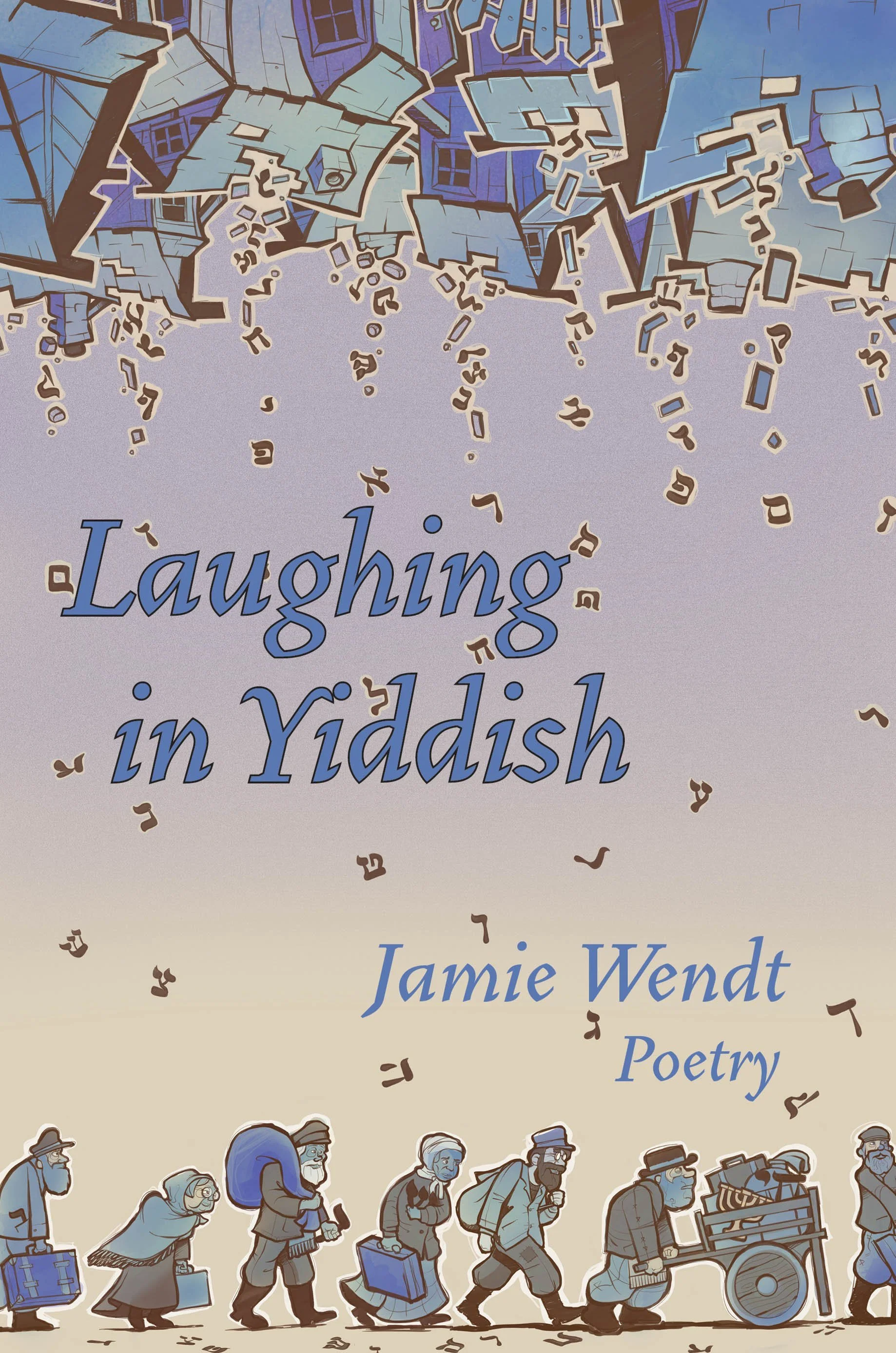
Laughing in Yiddish. Jamie Wendt, Broadstone Books, 2025, Paperback, 85 pages
Reviewed by Matthew Schnur.
Jamie Wendt’s Laughing in Yiddish is a remarkable and moving collection that explores the intersections of identity, language, memory, location, and faith within the Jewish diaspora. Wendt’s mastery lies not only in the depth of emotion and cultural nuance but also in her deft manipulation of tone, weaving sorrow, joy, tenderness and strength throughout the four sections of the collection.
Yocheved was the mother of three prophets, Miriam, Moses and Aaron. She hid Moses away for three months before setting him adrift in some reeds down river, to escape the pharaoh’s murderous troops.
The background story isn’t necessary to understand, in a few short lines, of the poem Yocheved, the power of women, as foundation of family and protector.
… in birth, like mine, she weaved
sacred coffins of hope. I silenced
a boy out of me, whom Pharoah’s men
would not steal and butcher. I alone
had decided that. And
I will always be waiting with the sand
city, my breath among the reeds,
weaving the wind with a lullaby
that will save my son.
Poems in this same theme include, Laughing in Yiddish, Ghosting,
The weight of history, of dislocation, of is apparent throughout, it is carried effortlessly by Wendt and her deft use of language.
In Uprooting a Tree this is succinctly and beautifully rendered in the opening lines:
There is always risk
when uprooting a tree.
Generation after generation,
we yank roots from earth
and no one can recall
the first seed, the place a root
splits. My tongue names anew species
in my sons who never understand…
Particular too, to this view of history, and its need for location; Ode to Maxwell Street struck particularly close to home. Anyone who was a visitor to Maxwell Street at its peak, will hear the blues playing over the din of car trunk commerce as they read. The feeling of loss of this true melting pot is equally real.
… Maxwell Street was a harmonica
In the lips of Chicago.
Italian, Jewish, and Mexican children
paused their pointing at jugglers
to watch open-mouthed
the awe of strings accompanying
low Black voices, feet tapping
with G-d…
Even when the furious ground shifted
its boundaries and construction
there was a way to listen
on Maxwell Street that passed on
to the children:…
The collection reports on the connection to the Jewish traditions and history through a number of “Interview(s) with Papa” that touch on different periods of time as experienced by the author’s grandfather. Interview with Papa: “Freeman” illustrates this neatly and with a great amount of reverence. The feeling was wanting to keep true to oneself but embrace the new location, new history as it’s created:
With stubborn intensity; we lived inside a creation myth.
To assimilate, Jews buried their foreign names in a myth.
…He was Pretcovitz and the Pratkoy before Freeman…
In practiced English, he shared dreams of planting trees for his future
children to climb, build from, eat its fruit, like carob in the Talmud, no myth.
The brief feeling 85 pages of Laughing in Yiddish are filled with beautiful, moving, and grounding poems which linger in memory long after completing the book. It is a tremendous showcase of Jamie Wendt’s talent.