Book Review: Gunmaker
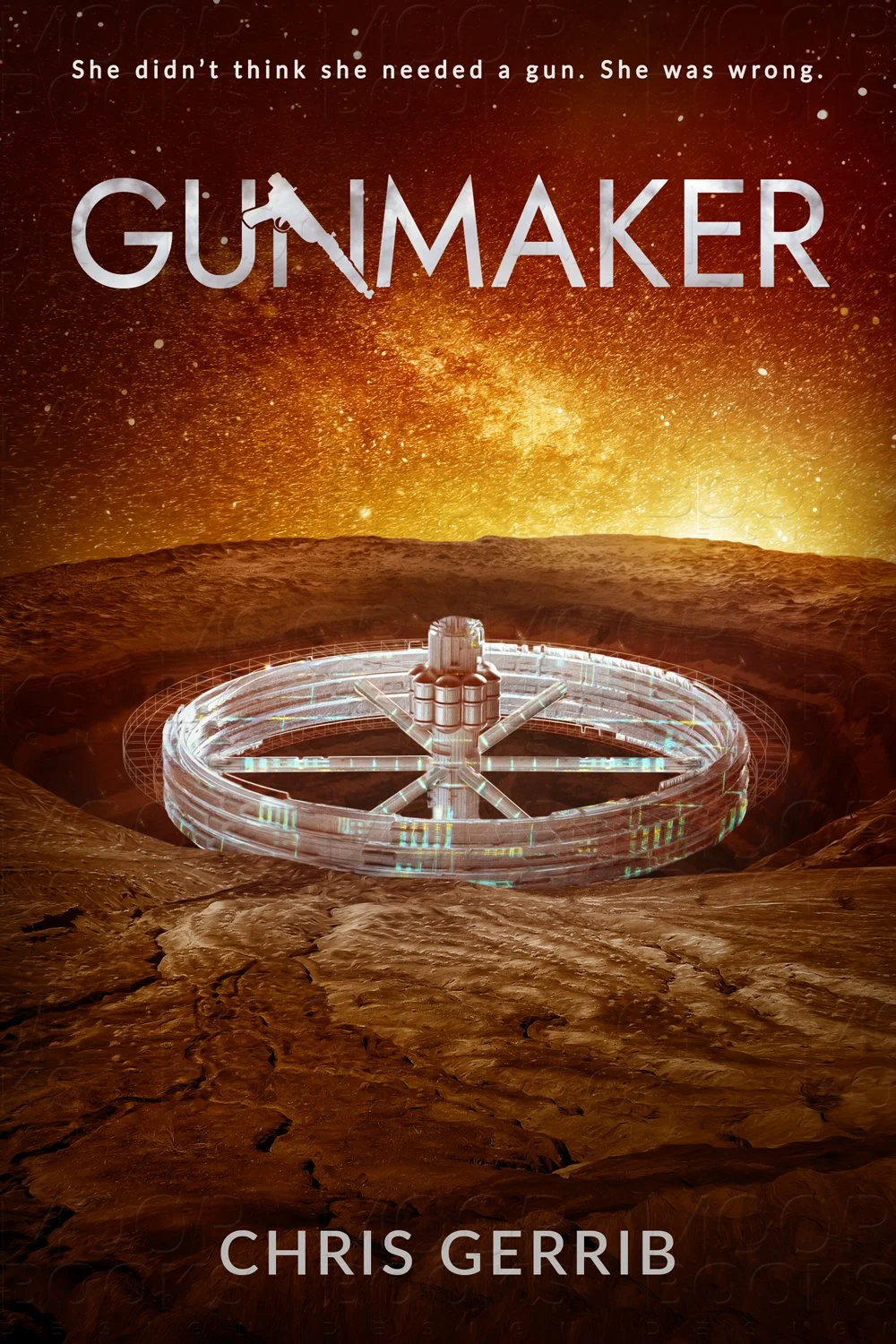
Gunmaker, Chris Gerrib, Space Wizard Science Fantasy, August 2026, print, 295 pages.
Reviewed by Philip Janowski.
Gunmaker is a science fiction novel following a mining colony’s revolution, from its quiet beginning to thunderous end. The setting is a fictional O’Neill torus space station named Gavin Station, buried inside the real near-Earth asteroid 433 Eros. To quote the opening pages of the novel: “[The station is] shaped like a tire or a doughnut. The Station is spun to produce one g of gravity—Earth Standard. The main floor of the station is one hundred meters wide with a ceiling one hundred meters above the floor! [...] From inside, the habitation space resembles a long narrow valley, climbing up at both ends. Artificial sunlight is provided by overhead lights…”
The novel follows three different women living on Gavin Station, exploring their lives after the killing of a drunk man by a police officer spirals out, ultimately upending the entire corrupt society. Even using the term “police officer” is problematic, as the legality of these officers—in fact hired and organized by a private company—is debated between the novel’s characters. Gavin Station itself is a “company town”: a place where virtually all of the stores and housing are owned by a single company.
The three women protagonists are all different forms of tough. Martika is the virtually sole legal representative of Gavin Station’s ruling company, 433 Platinum Mining LLC. She must decide whether to stick with or fight against 433 Platinum as its corruption becomes increasingly obvious. Karin is a burgeoning rebel leader, slowly realizing her role as tensions ratchet up. Doris is a female police officer investigating the disappearance of a young woman — the daughter of the killed drunk man.
Gunmaker reads similarly to a police procedural show such as Law & Order. The narration is very heavy on dialogue, and one can easily imagine the novel converted into a TV or film script. On the flip side, setting and character descriptions are quite sparse, and the reader will need to pay close attention to names to keep track of the plot. One protagonist, Doris, is introduced without any physical description. When settings and characters are described in narration, the focus is on aspects that would be physically visible in a TV program, such as an angry face or the movement from one location to another. Character motivations are often easy and fast; the desire for money is a constant theme. The revolution is kicked off not by any political philosophy or clearly delineated faction, but due to a plainly wrongful murder. The motives of the rebels do become bigger than this (company towns, even on a space station, are easily distasteful things) and more political motivations come into play as the story continues.
At times the dialogue is quite fun. When Martika is told that a bureaucrat signed a faulty legal paper, she says, “Good thing the office windows don’t open—he’d sign a leaf if it landed on his desk.” Several of the characters make odd references to mushrooms, references that pay off in a later punch line.
The book ends in a place that makes sense, but also with a clear sequel hook. Fans will have more to look forward to in the future.