Book Review: Daddy’s Little Stranger
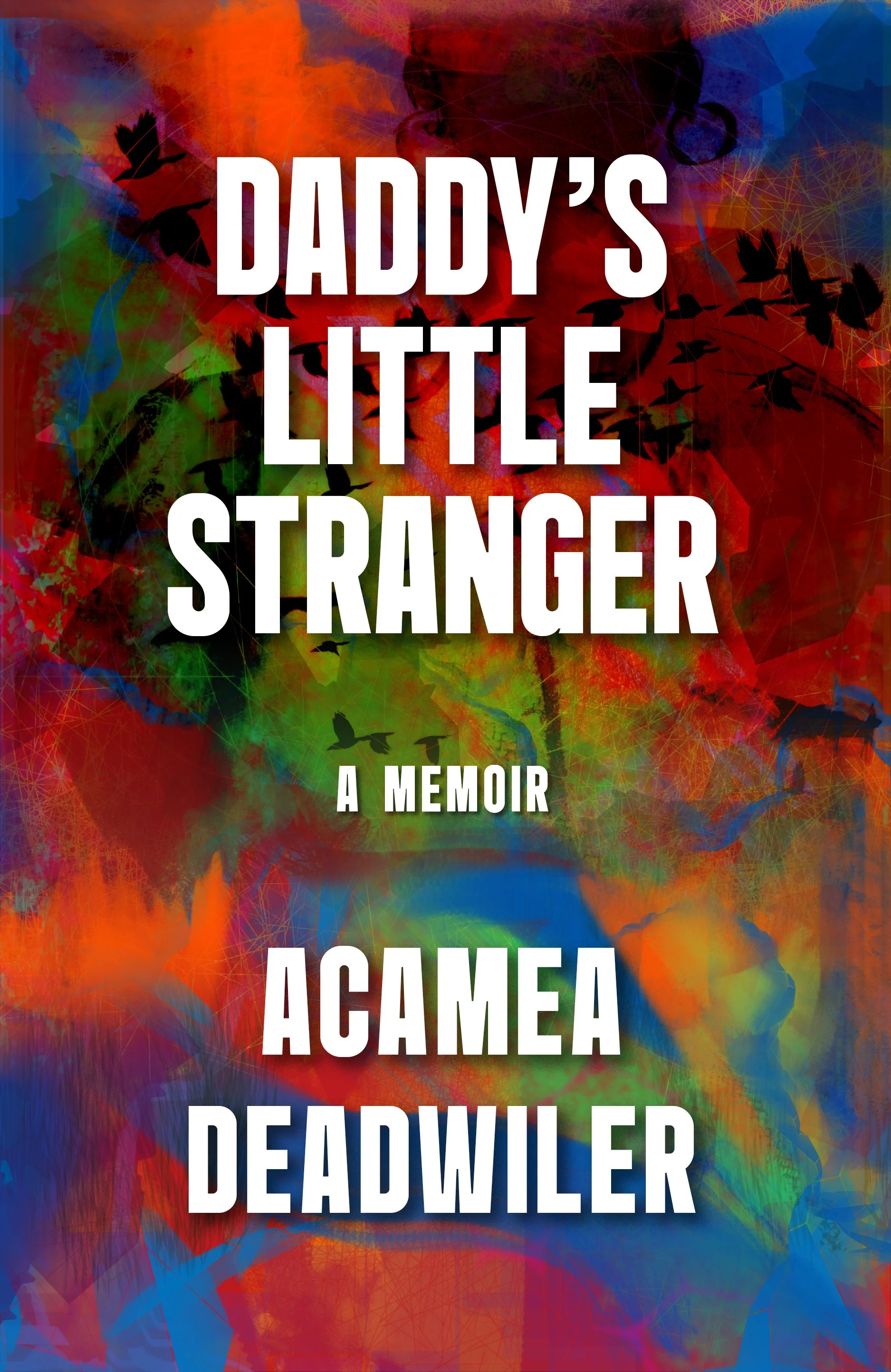
Daddy’s Little Stranger, Acamea Deadwiler, Riddle Brook Publishing, March 2024, print, 230.
Reviewed by Philip Janowski.
Daddy’s Little Stranger is a memoir by Acamea Deadwiler, focusing on her adolescence and young adulthood in Gary, Indiana. The book explores her relationships with her mother, biological father, and a series of stepfathers.
The book begins with an archetypal episode, almost a thesis for the rest of the narrative: in the 1980s, a very young Acamea waits at the window for her biological father to visit. While sitting, Acamea stares at the window’s rusty metal bars and thinks of a happy last outing with her father. But her father never arrives.
Soon after this we drop into a harsh episode reminiscent of A Child Called “It”, an incident fostered by an absent stepfather and a mother suffering a nervous breakdown. “When the [food] ran out, so did our ideas. [With myself] at five and [my brother at] four years old, we’d reached the limits of both our bravery and creativity.” Nothing gets quite this drastic again, and afterwards, Acamea grows up in a more physically stable but also more emotionally complex household. A series of stepfathers pass through her life: Terry, Kareem, and Richard. Acamea’s birth father remains distant and mysterious, known simply as “Champ” for the majority of the book.
In a powerful passage, Acamea describes her home city of Gary: “Overcome with poverty, the city is riddled with burned down and forsaken buildings, uninhabited housing communities, and roads destroyed by potholes. [...] Every single school I attended in my hometown has closed its doors. Yet, there’s a liquor store within a few blocks of wherever you might be. [...] Not even businesses that profit from despair could survive Gary’s collapse, given there were fewer residents left to exploit.”
‘Despair’ is a word relevant to many parts of the memoir, the despair of the conscious person who wishes for better, who feels a sense of responsibility to move toward that better — and yet struggles to find it. “I am too young to feel this old. To be this tired. Lord, can I be anyone but myself?”
Acamea goes on to attend university, attain a master’s degree, and become a financially independent woman. But the path is emotionally treacherous, and the willpower and support that helps Acamea reach individual success is never the true focus of the memoir. Acamea’s relations with her extended family stand at the center of the narrative, and while undoubtedly a sense of love—however strained—connects these characters, an endless ambiguity casts shadows over every bond. “Independence: was that the thing on the other side of my longing? Or was it isolation? I wanted to be alone, more alone than I’d always been. More aloneness than I’d found locking myself in my bedroom away from my family. Because in aloneness nothing was expected of me and there was no one for me to expect anything of, and this meant we could not let each other down.”
Daddy’s Little Stranger brings a sense of emotional authenticity so often integral to a worthwhile memoir. The author is not afraid to be vulnerable, and talks about those moments of surprising pain and unexpected happiness that we all experience in some form. The writer of this article enjoyed quoting from the book more often than they usually do, inspired by the many concise, immediately resonant passages throughout the text.
Real life rolls on. This is not a novel where the protagonist is crowned with some obvious material, emotional, or spiritual victory at the end. Some good happens, some bad. In the end, it’s just enough to hug someone and tell them that “it’s okay.”