Book Review: Confirmation Bias
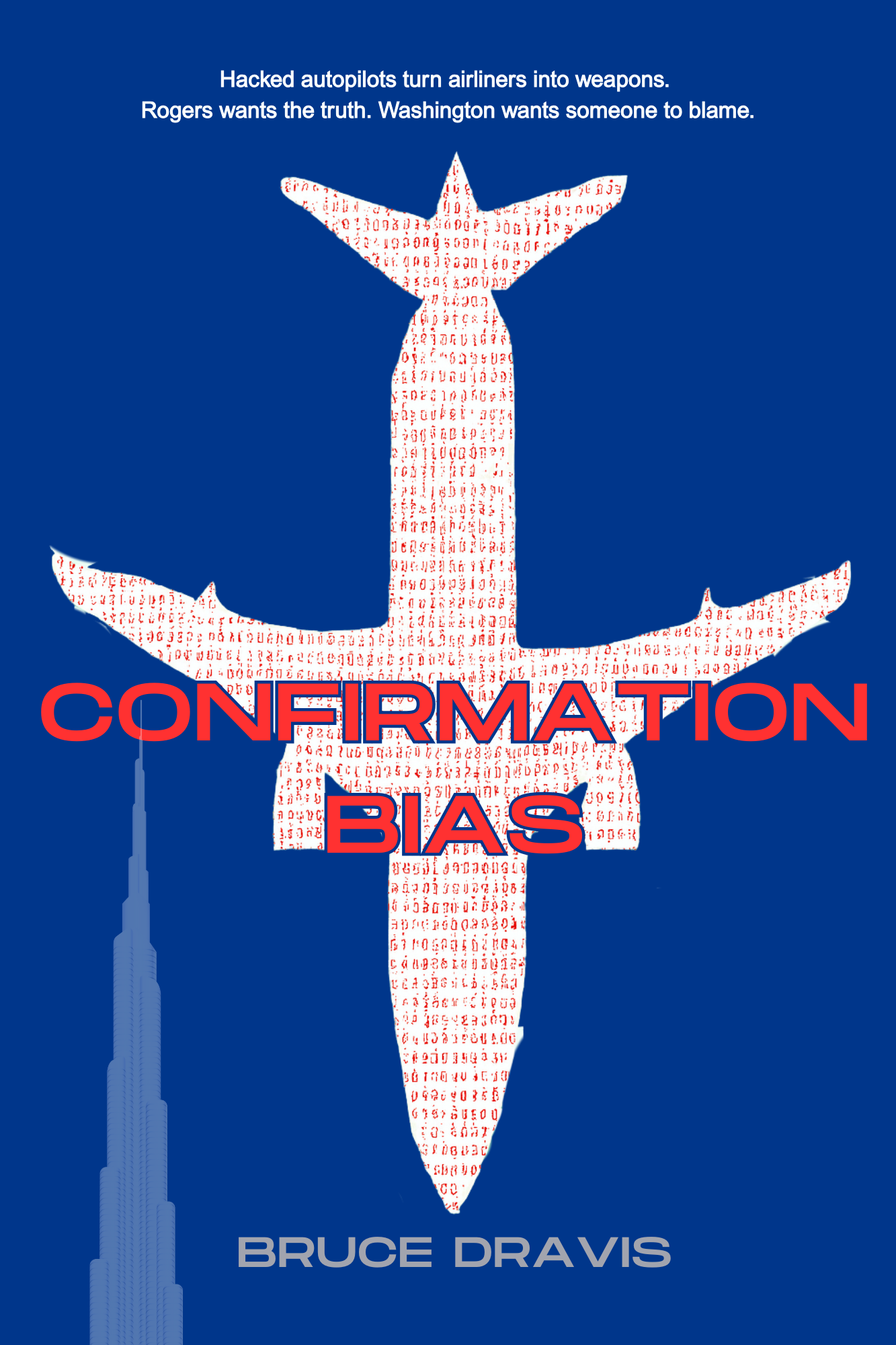
Confirmation Bias. Bruce Dravis, The Paper House, November 2025, e-book and paperback, 228 pages.
Reviewed by Shanti Nagarkatti.
Confirmation Bias by Bruce Dravis is an espionage thriller that asks readers to question not only what they believe, but why they believe it. The novel follows Anthony Rogers, a West Point professor and Iraq war veteran, along with an ensemble cast of characters drawn from journalism, politics, academia, and business.
Following two 9/11-style commercial passenger jet attacks in the Middle East, Washington pundits are proclaiming a new era of airliner terrorism. Rogers is skeptical of the convenient explanations taking shape.
He teaches courses on thinking biases and is convinced that many of the factors that support the explanation of terrorism are absent. Presenting to government officials, Rogers states, “The folk saying is that when you have a hammer, every problem is a nail. In the research on cognitive errors, the term is ‘confirmation bias’ – the tendency to over-value information that supports your theory, and to dismiss contradictory or missing data.”
Joining a Pentagon investigation, Rogers learns that the perpetrators seized control of autopilots to steer civilian aircraft into their targets, using an anti-terrorism technology abandoned by the CIA. Rogers’ findings, and those of parallel FBI and counterintelligence probes, identify an international cabal including a mid-level CIA analyst, a hedge fund, and a politically connected industrialist.
Rogers is determined to prove his theory and uncover American involvement but is no match for Washington insiders who remain unconvinced. He is on the verge of quitting when a new threat emerges. Rogers realizes that for his own protection he must expose the hidden schemers who are protecting the attackers for reasons of their own.
One of the novel’s greatest strengths is its realism. Although the book is set in 2016, elements such as geopolitical tensions, disinformation, money laundering, and cyber threats feel prescient. Additionally, flashbacks at the beginning of each section to Rogers’ service in the Middle East heighten the sensory detail, bringing emotional depth to this character’s backstory and motivations.
Dravis excels at capturing the interplay between journalists, politicians, and government agencies. The dialogue and sparring feel spot-on. Some of this might arise from the author’s background as a former journalist. The level of detail used to describe aspects such as briefings, interviews, and closed-door meetings reflects what appears to be extensive research.
The title is also well chosen. Rather than using confirmation bias as a fleeting reference, the plot centers on the dangers that arise when those in positions of power rely solely on evidence that supports a preferred conclusion. A focus on logic and evidence lends intellectual weight to themes of institutional pressure and the trade-offs made in the name of national security.
The pacing is measured, reflecting the complexity of the investigation and shifting alliances. While the novel requires careful reading, its journal-dated format provides a framework to help readers navigate changes in setting and multiple narrative points of view.
Confirmation Bias is an excellent choice for fans of espionage fiction as well as readers who appreciate a suspenseful story that could easily be plucked from today’s headlines.